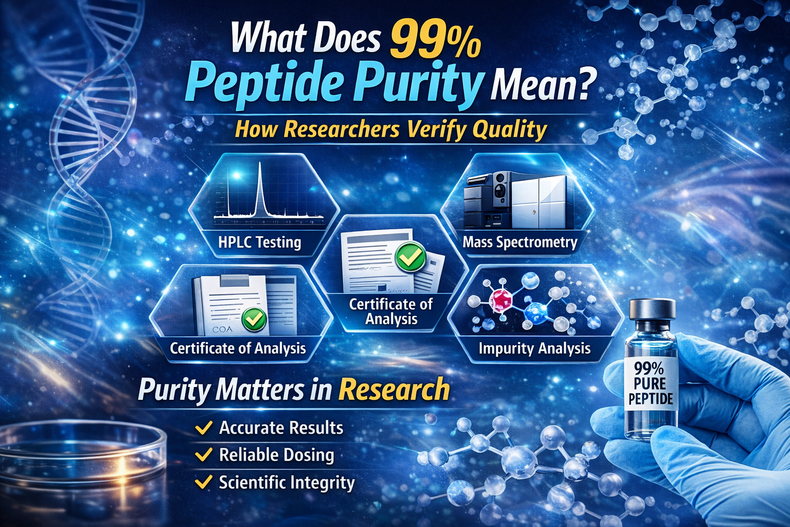
How Hplc Is Utilized To Examine Peptide Pureness For peptides, contamination expectations comply with a risk-based FDA technique, as opposed to the small-molecule limits in ICH Q3A/Q3B (which exclude peptides). Peptide-related contaminations present at low-percent degrees (e.g., around 0.1% and over) normally require characterization, and higher-level or new Helpful hints contaminations may need enhanced justification due to potential immunogenicity worries. FDA advice and ICH Q2( R1) help specify requirements for logical approach recognition and contamination evaluation for peptide medicine products. Pharma business seeking to establish peptide-based drugs need a strong QC screening program. This is important due to the fact that it enables them to satisfy regulative assumptions and obtain approval for peptide medications. Crude peptides undergo gel filtration adhered to by HPLC filtration. HPLC filtration is executed by the state-of-art HPLC system with Empower Chromatography Manager. The system is validated by authorized Waters validation specialist to abide by FDA requirements. The pureness of the peptide is validated by running logical HPLC adhered to by mass range evaluation. Researchers then determine just how much of the total signal comes from the major peak. If 98% of the signal comes from the right peptide, the product is classified "98% pure by HPLC." This is a common means of sharing peptide high quality throughout research and pharmaceutical industries. Knowing exactly how to examine peptides for pureness guarantees the integrity and reproducibility of every study method. This guide describes the 3 gold-standard logical methods-- HPLC, mass spectrometry, and third-party testing-- and exactly how researchers can translate outcomes to confirm that their compounds satisfy research-grade quality requirements. Without orthogonal approaches to identify these microheterogeneities, they multiply in a system (death as 'organic variability'), decreasing signal-to-noise and eventually invalidating whole information collections. Formal HPLC/MS characterization freezes that decline in place, subjecting each particle to two orthogonal choice stress (hydrophobicity and mass-to-charge), developing an analytical firewall around incorrect identity. Common pureness levels range in between 99.0% and 99.7%, lining up with worldwide lab research study standards. These tests verify that peptides from Peptides Lab UK contain no pollutants, deterioration spin-offs, or unwanted fillers-- just confirmed, high-purity research https://judahfbnm963.fotosdefrases.com/advanced-peptide-research-with-reputable-science-driven-remedies material. Microbiological condition of tidy area regulated atmospheres are assessed by keeping track of the society of bacteria in the laboratory working areas.
Peptides Laboratory Uk
At Verified Peptides, every peptide batch goes through extensive HPLC analysis as part of our quality assurance. We use independent third-party labs for analytical testing of each set to acquire unbiased HPLC and MS data validating the peptide's identity, pureness, and composition [3] The HPLC chromatogram should reveal a clean profile meeting our stringent pureness requirements (≥ 95% purity, with most batches really surpassing 98%) [4] Any batch that drops below our purity standards or displays unexpected pollutant tops is re-purified or disposed of.Our Analytical Techniques
Just how much does peptide HPLC testing cost?
The cost of peptide evaluation solution differs dramatically based upon which methods your governing package calls for: HPLC-UV Analysis: $& #x 24; 300 & #x 2013; & #x 24; 800 per sample (typical pureness evaluation) LC-MS (Liquid Chromatography-Mass Spectrometry): $& #x 24; 600 & #x 2013; & #x 24; 1,500 per sample (molecular weight confirmation).
- You can confirm authenticity by checking the COA confirmation code through the screening laboratory's web site.HPLC and Mass Spectrometry provide the gold-standard guarantee that what remains in the vial is pure, precise, and specifically what the tag states.Request information on instrumentation, detection restrictions, and validation standing before submitting examples.With analytical testing, producers can confirm that peptide-based medicines satisfy governing requirements.Convert vial strength, water quantity, and recommendation dose right into specific syringe systems.For peptide purity screening, reverse-phase HPLC is the conventional conceptual version.